
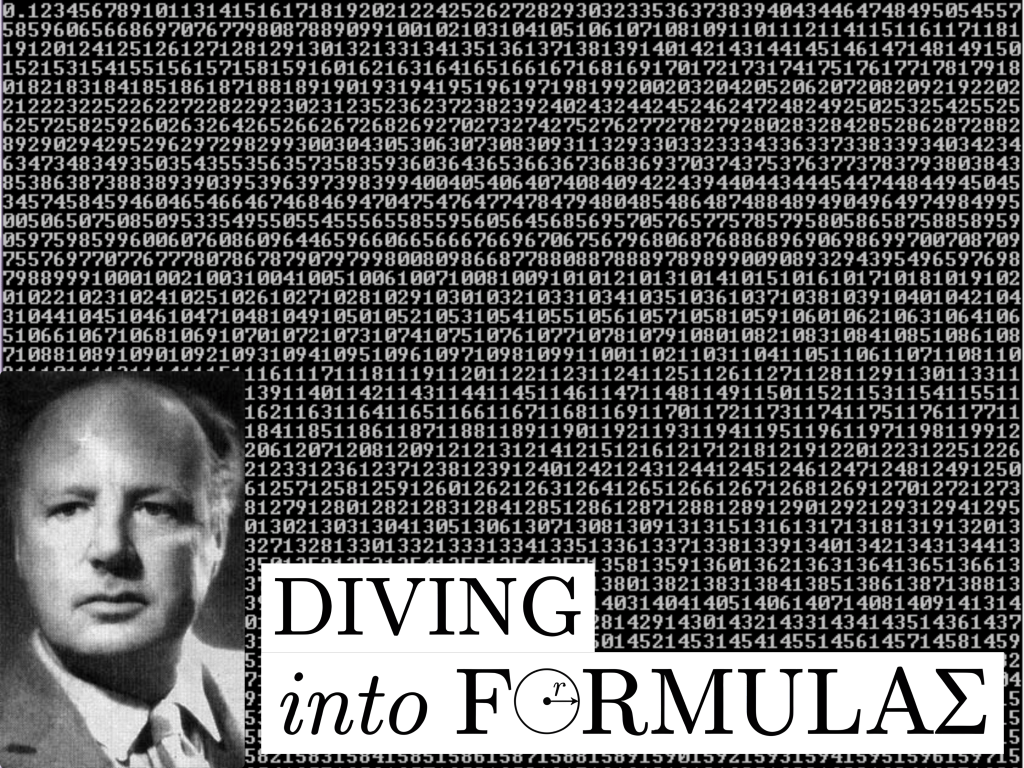
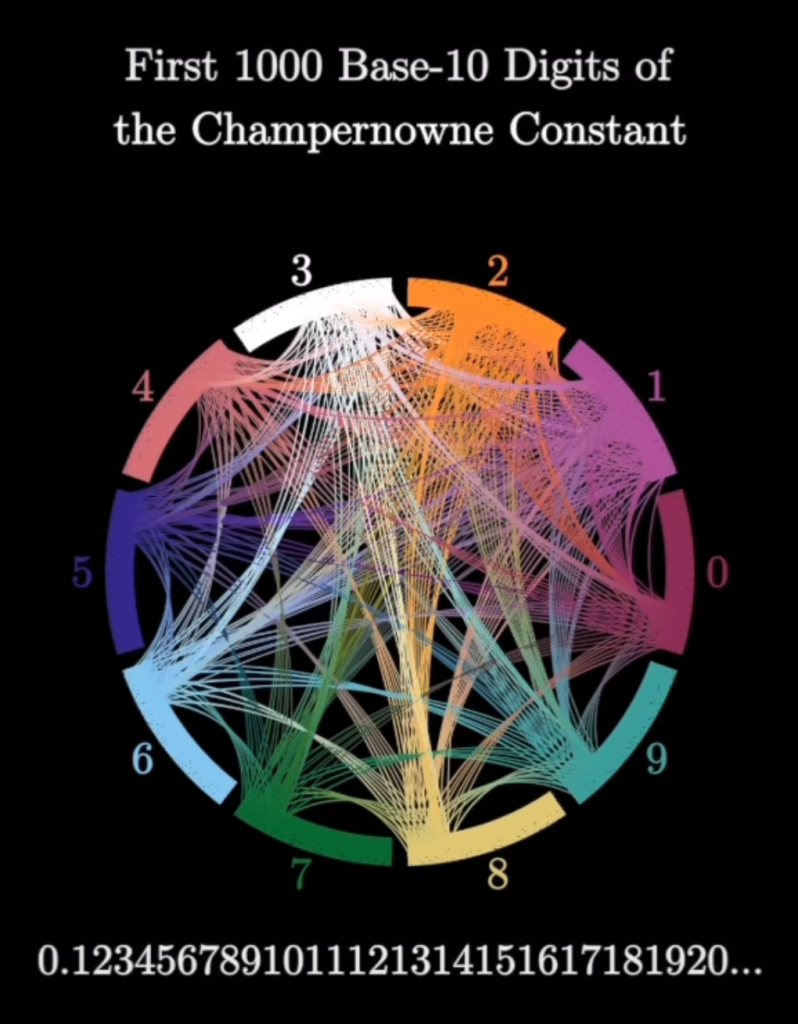
Imagine trying to create an infinitely complex number using the simplest rule in the world: counting. If you take a zero, a decimal point, and start writing every natural number one after the other, you get this:
This seemingly elementary mathematical object is the Champernowne constant . Behind its disarmingly simple structure hides one of the most fascinating monsters in number theory, capable of containing the entirety of human knowledge while redefining the very concept of “controlled randomness.”
The Extraordinary Properties of an “All-Inclusive” Number
At first glance, the constant looks almost like a rational number because of its obvious pattern. On the contrary, it possesses three fundamental characteristics that make it a pillar of modern mathematics:
- Absolute Transcendence: Not only is it irrational (it cannot be expressed as a fraction), but the mathematician Kurt Mahler proved in 1937 that it is transcendent. This means it is not the root of any polynomial equation with integer coefficients, placing it in the same “numerical aristocracy” as and Euler’s number .
- The Library of Babel (Disjunctivity): The constant is a disjunctive sequence. Because it lists every existing whole number, it inevitably contains any imaginable finite string of digits. Your date of birth, your phone number, or the binary code of the entire Divine Comedy is already written somewhere inside its decimals.
- The Perfect Democracy of Digits (Normality): Champernowne did not create this number as a game, but to prove the existence of a normal number. In base 10, every single digit from 0 to 9 appears with an asymptotic frequency of exactly 10%. Any pair of digits (like “42”) appears 1% of the time, every triplet 0.1%, and so on. There is a perfect order in the distribution, despite a total absence of periodicity.
David Gawen Champernowne: The Eclectic Genius Behind the Constant
Many would expect such a milestone to bear the name of a pure mathematician who spent his life immersed in equations. Instead, the story of David Gawen Champernowne (1912–2000) is that of a brilliantly undisciplined and versatile mind.
Born in Oxford, Champernowne showed a crystal-clear talent for numbers from an early age. In 1933, while still a 21-year-old undergraduate student at King’s College, Cambridge, he published the scientific paper that made him immortal in the world of mathematics. He invented his constant as a practical, constructive example to answer a complex theoretical challenge: proving that creating a normal number was possible and even elementary.
His Friendship with Alan Turing and the First Chess Computer
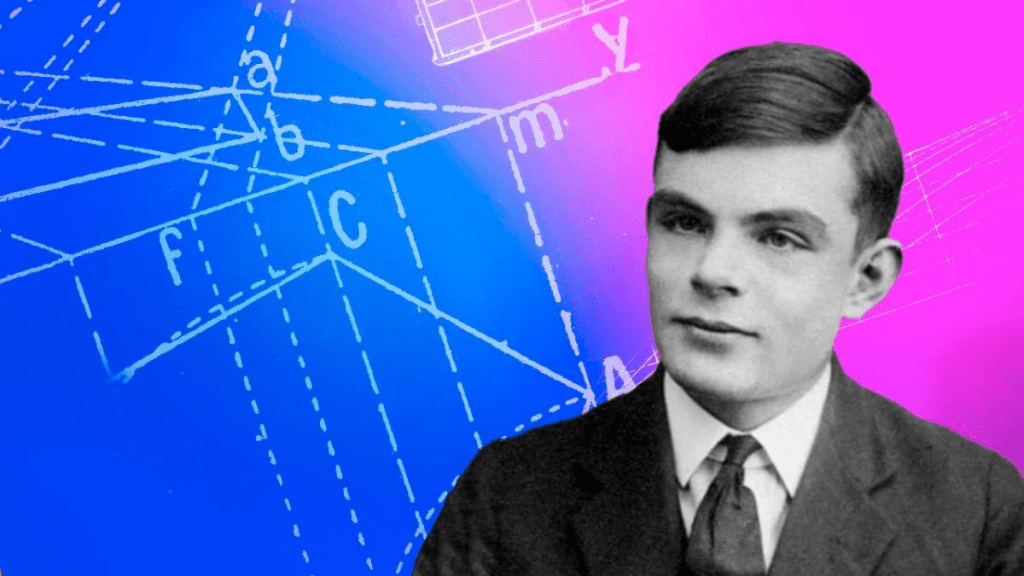
At Cambridge, Champernowne forged a deep and lasting intellectual friendship with Alan Turing, the father of computer science. The two shared a passion for logic and strategy games.
In 1948, long before commercial computers capable of running it existed, Champernowne and Turing designed and hand-wrote the code for Turochamp, one of the very first programs in history capable of playing chess. Lacking a machine powerful enough to run it, the two scientists manually simulated the algorithm on paper, taking up to half an hour to calculate each move.
Keynes’ Advice and the Turn to Economics
Despite his dazzling debut in number theory, the famous economist John Maynard Keynes (then a lecturer at Cambridge) sensed the young man’s analytical potential and suggested a change of direction. Champernowne took the advice: he completed his mathematics degree in just two years and took a second degree in economics.
He went on to become a highly esteemed professor of statistics and economics at both Oxford and Cambridge, leaving a significant mark on the study of income distribution and economic inequality models. Those who knew him described him as a modest, witty man, an untiring walker, and a passionate choir singer—completely indifferent to academic fame and entirely devoted to the advancement of knowledge.
Why is this Constant still Fascinating?
The Champernowne constant reminds us that complexity does not always require arcane formulas. A single-line algorithm — “write the numbers in a row” — generates a transcendent and mathematically perfect structure.
While mathematicians still struggle today to prove whether natural numbers like or are actually normal (even though everything points to it), the creation of this eclectic British academic has stood for nearly a century: living proof that infinity can be tamed with a simple piece of paper and pure logic.
How can it be Really Useful, tough?
In the field of pure mathematics and theoretical computer science, the Champernowne constant is much more than a mathematical curiosity. While you cannot use it to calculate the bridge structural load or to program a commercial smartphone app, its utility lies in its role as a theoretical benchmark and a proof of concept.
1. A Weapon Against the “Decidability” Problem
Before Champernowne, mathematicians knew that “normal numbers” must exist because of Émile Borel’s theories, but they could not easily point to one and say, “Here it is, look at it.”
Champernowne provided the very first explicit, easily constructible example of a normal number. This utility is foundational: it proved that normality is not just an abstract, unreachable property, but something that can be built deterministically with a basic rule.
2. Testing the Power of Computers (BBP-Type Algorithms)
In computer science, testing how well an algorithm can generate specific digits at extreme depths is crucial. Because we know the exact rule of the Champernowne constant, it is used to test digit-extraction algorithms.
Scientists use it to check if a computer can calculate the digit of a transcendental number directly without calculating all the preceding digits. If an algorithm fails to find the digit of Champernowne’s constant quickly, it stands no chance against or .
3. Pseudo-Random Number Generation (PRNG)
Even though the constant is completely deterministic (we know exactly what digit comes next), its statistical distribution is perfectly uniform.
In early computing and cryptography theory, the constant was studied to see how deterministic sequences could mimic true randomness. It helps researchers understand how to generate “pseudo-random” data streams where every single sequence of numbers is guaranteed to appear with perfect statistical balance.
4. Defining “Randomness” in Algorithmic Information Theory
How do you mathematically prove that something is random? This is where the constant serves as a perfect counter-example.
- According to Borel’s definition of randomness (statistical normality), Champernowne’s constant is perfectly random.
- According to Kolmogorov’s definition of randomness (complexity), it is not random at all, because a very short computer program can generate it.
By straddling this line, the constant helped computer scientists refine the definition of what makes data truly random versus just looking random.
Bibliography & Further Readings
Champernowne, D. G. (1933). The Construction of Decimals Normal in the Scale of Ten. Journal of the London Mathematical Society, 8(4), 254–260.
Introduces the Champernowne constant and provides the first explicit construction of a normal number in base 10.
Mahler, K. (1937). Arithmetische Eigenschaften einer Klasse von Dezimalbrüchen. Proceedings of the Koninklijke Nederlandse Akademie van Wetenschappen, 40, 421–428.
Proves that the Champernowne constant is transcendental.
Borel, É. (1909). Les probabilités dénombrables et leurs applications arithmétiques. Rendiconti del Circolo Matematico di Palermo, 27, 247–271.
Introduces the concept of normal numbers and establishes their theoretical existence.
Li, M., & Vitányi, P. (2008). An Introduction to Kolmogorov Complexity and Its Applications (3rd ed.). Springer.
A standard reference on algorithmic randomness and Kolmogorov complexity, explaining why the Champernowne constant is statistically normal but algorithmically simple.
Copeland, B. J. (Ed.). (2004). The Essential Turing. Oxford University Press.
Provides historical context on Alan Turing’s work, including the development of the Turochamp chess program with David Gawen Champernowne.


Leave a comment