For decades, the consensus on artificial intelligence in academia was clear: AI is great at crunching data, generating text, and playing chess, but it cannot do original abstract mathematics. It couldn’t invent new concepts or solve problems requiring genuine creative leaps.
That consensus just shattered.
In a series of historic breakthroughs, AI systems have actively disproved and resolved long-standing mathematical problems—most notably, the famous conjectures of Paul Erdős, one of the most prolific mathematicians of the 20th century.
Here is how AI went from a glorified calculator to a peer-reviewed mathematical collaborator.
The Breakthrough: Overturning an 80-Year-Old Conjecture
The biggest shockwave hit the mathematical community when researchers at OpenAI announced that an AI reasoning model had successfully disproved an 80-year-old combinatorial geometry problem proposed by Erdős in 1946: The Unit Distance Problem conjecture.
The Problem Erdős wanted to know: if you place N points on a flat piece of paper, what is the maximum number of pairs that can be exactly a unit distance (e.g., 1 inch) apart? Erdős conjectured a strict upper bound, believing a regular, square grid arrangement was the most efficient way to maximize these pairs.
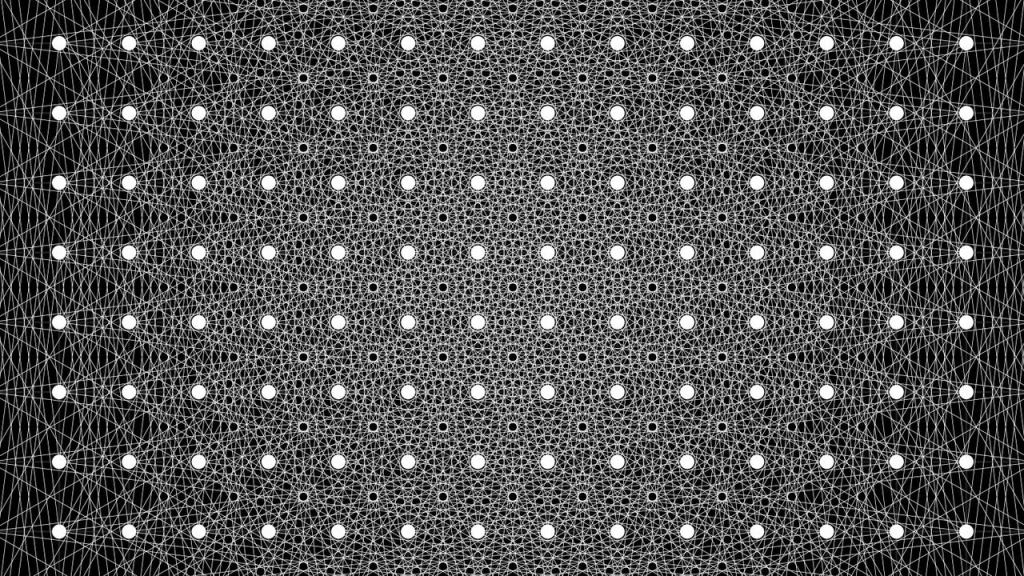
A representation of the AI’s solution
The AI’s Solution
Instead of looking at a flat plane, the AI model thought in reverse. It worked under the assumption that Erdős was wrong.
It constructed a highly complex, symmetrical grid in a higher-dimensional space.
It then mathematically projected that high-dimensional grid back down into a two-dimensional “shadow.”
The resulting structure completely broke Erdős’s predicted limit, proving that you can pack dots together to create vastly more equal distances than human experts thought possible.
“It’s a beautiful piece of mathematics that has been discovered,” noted Melanie Matchett Wood, a mathematician from Harvard University.
It Wasn’t a Fluke: The Rise of AI Math Agents
OpenAI’s breakthrough isn’t an isolated incident. The landscape of pure mathematics is being aggressively rewritten by several AI powerhouses:
OpenAI & Harmonic (Aristotle): Earlier, an AI system utilizing a reasoning model autonomously resolved Erdős Problem #728 (regarding factorial divisibility). It didn’t just write out an informal argument; it integrated with Lean (a formal proof verifier) to output a completely bulletproof, verified mathematical proof.
Google DeepMind (Gemini Deep Think & AlphaProof): DeepMind launched its AI for Math Initiative, deploying models that achieved gold-medal-level performance at the International Mathematical Olympiad (IMO) and autonomously solved multiple open questions across geometry, combinatorics, and number theory.
How is AI Solving Things Humans Couldn’t?
If AI doesn’t “think” like a human, how is it making these breakthroughs?
Historically, AI failed at math because it tried to guess the next word statistically. The new generation of AI relies on advanced reasoning and exhaustive exploration. AI excels at brute-forcing its way through massive, discrete spaces with verifiable objectives. It doesn’t get tired, it doesn’t have cognitive bias, and it is perfectly willing to test highly unconventional mathematical approaches—like blending algebra and number theory in ways a human graduate student might never attempt.
The “Leiden Declaration” and the Future of Math
The sudden influx of AI-generated proofs has moved so fast that it has triggered anxiety among human scholars.
A group of prominent international mathematicians published the Leiden Declaration, calling for tight guardrails on AI research. The community is grappling with profound questions:
The “Black Box” Problem: AI can generate a 100-page calculation that proves a point, but it doesn’t explain why or how it thought of the strategy.
Lack of Inspiration: While AI is incredible at finding counterexamples and optimizing bounds, experts note it still lacks the “spark of genius” required to build entirely new branches of mathematics from scratch.
The Verdict
AI is no longer just a tool for writing code or drafting emails. It has officially entered the realm of high-level, abstract human thought. While AI might not replace the deep, conceptual intuition of human mathematicians anytime soon, it has proven itself to be an unstoppable co-pilot.
The mathematical frontiers that once took generations to cross are now falling over the course of an afternoon.
Brief Bibliography
Google DeepMind’s AlphaProof & AlphaGeometry
Source: Google DeepMind Research (2024–2026). “AI solves International Mathematical Olympiad problems.”
The Lean Proof Verifier & AI Integration
Source: Quanta Magazine. “Lean Mathematical Verification Software and the Future of Proofs.”
Terence Tao on AI in Pure Mathematics
Source: Tao, T. (Mathematical Sciences Research Institute blog / MathOverflow discussions).
The Erdős Problems Database
Source:Erdosproblems.com (Maintained by the University of California, San Diego).



Leave a comment