

In the 1960s when Japan entered its high economic growth period, supermarkets selling a wide range of commodities from foodstuff to clothing began to spring up in many neighborhoods.
Cash registers that were then used at checkout counters in these stores required the price to be keyed in manually. Because of this, many cashiers suffered from numbness in the wrist and carpal tunnel syndrome.
“Cashiers desperately longed for some way to lighten their burden.”
The invention of barcodes provided a solution to this problem. Subsequently the POS system was developed, in which the price of an item of merchandise was displayed on the cash register automatically when the barcode on the item was scanned by an optical sensor, and information on the item was sent to a computer at the same time.
As the use of barcodes spread, however, their limitations became apparent as well. The most prominent was the fact that a barcode can only hold 20 alphanumeric characters or so of information.
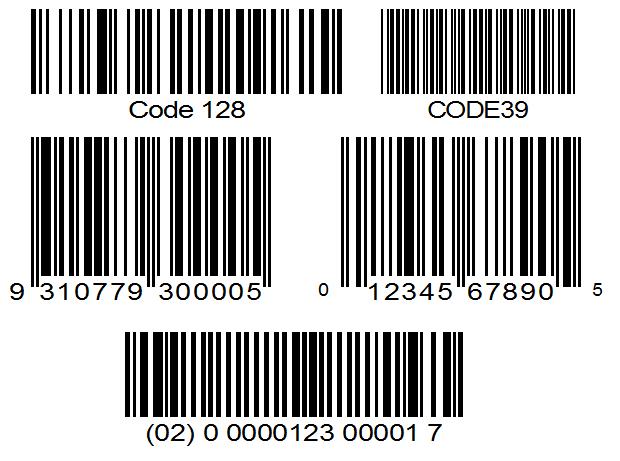
Users contacted DENSO WAVE INCORPORATED (then a division of DENSO CORPORATION) who were developing barcode readers at that time to ask them whether it was possible to develop barcodes that could hold more information, saying, “We’d like the capability to code Kanji and Kana characters as well as alphanumeric ones.”
Encouraged by these enthusiastic requests, a development team at DENSO WAVE embarked on the development of a new two-dimensional code, all out of their sincere desire to accommodate users’ needs.
Looking back on those days, Masahiro Hara in charge of the development of the QR Code then remembers that people who were developing 2D codes at other companies were all obsessed with packing as much information as possible into their codes.
With barcodes, information is coded in one direction (one dimension) only. With 2D codes, on the other hand, information is coded in two directions: across and up/down., Out of a strong desire to develop a code that could be read easily as well as being capable of holding a great deal of information, Hara set out to develop a new 2D code. He dared to try this with only one other person as his team member.

The greatest challenge for the team was how to make reading their code as fast as possible. One day, he hit on the idea that their problem might be solved by adding positional information indicating the existence of a code to be read.
This was how the position detecting pattern made up of square marks came into being. By incorporating these marks into their code, high-speed reading became possible.
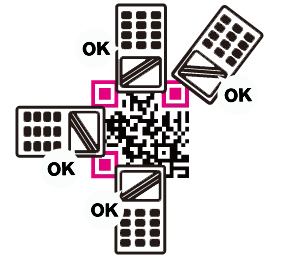
So far so good, but why did the marks have to be squares rather than any other shape?
According to Hara this was because “it was the pattern least likely to appear on various business forms and the like.”
If a position detection pattern is used in a code and there is a similar-looking mark nearby, the code reader may mistake it for the position detection patterns. To avoid this type of erroneous reading, their position detection patterns had to be truly unique. After mulling over this problem thoroughly, they decided to do an exhaustive survey of the ratio of white to black areas in pictures and symbols printed on fliers, magazines, cardboard boxes and so on after reducing them to patterns with black and white areas.
They continued the task of surveying innumerable examples of printed matter all day long for days on end. Eventually, they came up with the least used ratio of black and white areas on printed matter. This ratio was 1:1:3:1:1. This was how the widths of the black and white areas in the position detection patterns were decided upon. In this way, a contrivance was created through which the orientation of their code could be determined regardless of the angle of scanning, which could be any angle out of 360°, by searching for this unique ratio.
A year and a half after the development project was initiated and after innumerable and repeated trial and error, a QR Code capable of coding about 7,000 numerals with the additional capability to code Kanji characters was finally created. This code could not only hold a great deal of information, but it could also be read more than 10 times faster than other codes.
The initial alternating-square design presented by the team of researchers, headed by Masahiro Hara, was influenced by the black counters and the white counters played on a Go board; the pattern of position detection was found and determined by applying the least-used ratio in black and white areas on printed matter, which cannot be misidentified by an optical scanner.
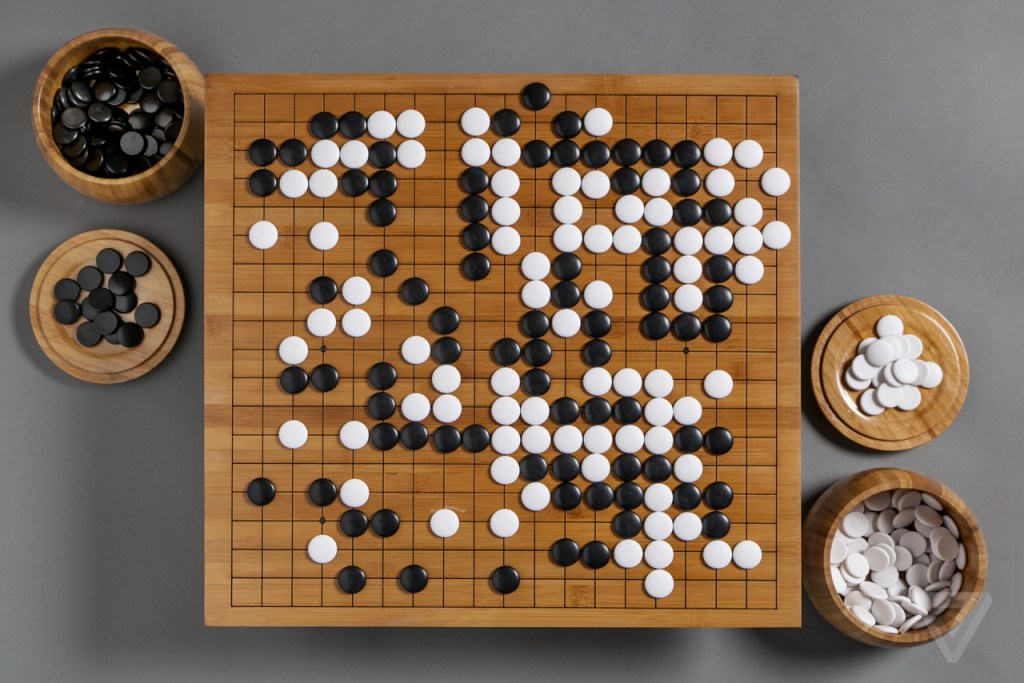
GO; an ancient board game
We talked about Go and Go boards, which inspired Masahiro Hara, but what is this game? Go is an abstract strategy board game for two players in which the aim is to capture more territory than the opponent by fencing off empty space. The game was invented in China more than 2,500 years ago and is believed to be the oldest board game continuously played to the present day. A 2016 survey by the International Go Federation’s 75 member nations found that there are over 46 million people worldwide who know how to play Go, and over 20 million current players, the majority of whom live in East Asia.
The playing pieces are called stones. One player uses the white stones and the other black. The players take turns placing their stones on the vacant intersections (points) on the board. Once placed, stones may not be moved, but captured stones are immediately removed from the board. A single stone (or connected group of stones) is captured when surrounded by the opponent’s stones on all orthogonally adjacent points. The game proceeds until neither player wishes to make another move.
When a game concludes, the winner is determined by counting each player’s surrounded territory along with captured stones and komi (points added to the score of the player with the white stones as compensation for playing second). Games may also end by resignation.
The standard Go board has a 19×19 grid of lines, containing 361 points. Beginners often play on smaller 9×9 and 13×13 boards, and archaeological evidence shows that the game was played in earlier centuries on a board with a 17×17 grid. Boards with a 19×19 grid had become standard, however, by the time the game reached Korea in the 5th century CE and Japan in the 7th century CE.
This is the End
I would have never imagined that QR Codes had such a big impact on the world! It is considered one of the most important inventions of all times! See ya next in the next post : )
A really fascinating post! Who knew the impact of QR codes on modern society? Always a pleasure to discover something new
Raffaella – Italy


Leave a comment