
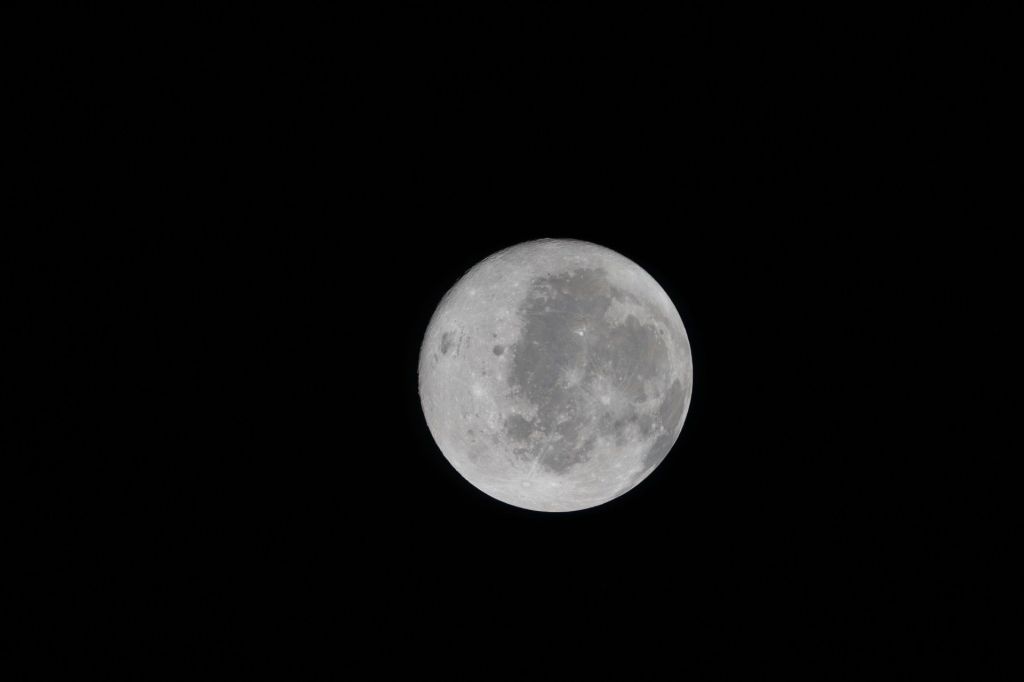
April 6-7, 2026
After more than half a century of absence, human beings are once again in the vicinity of the Moon. Artemis II is an ongoing United States spaceflight mission that sent four astronauts on a flyby around the Moon, launching from Kennedy Space Center on April 1, 2026. The mission crew — NASA astronauts Reid Wiseman, Victor Glover, and Christina Koch, along with Canadian Space Agency astronaut Jeremy Hansen — lifted off at 6:35 p.m. EDT on April 1.
It is, without exaggeration, a generational milestone. It is the first crewed mission beyond low Earth orbit since Apollo 17 in December 1972.
The Road to Launch
Getting here wasn’t straightforward. The mission was originally expected to fly in 2025, but the schedule was delayed by more than two months due to investigations into issues with Orion’s life-support system and unexpected heat-shield damage observed after the Artemis I reentry. Specifically, post-flight inspections of the Artemis I capsule found areas of char loss in the AVCOAT ablative material, in which portions of the material eroded more extensively than predicted by preflight models.
The debate over whether to fly with the existing heat shield was a real one. In January 2026, NASA Administrator Jared Isaacman stated that he supported proceeding with Artemis II using the existing heat shield after reviewing the agency’s analysis and meeting with engineers and outside experts. Design changes for future missions are already in the works: changes addressing AVCOAT permeability are planned for the heat shield intended for Artemis III.
Rocket stacking proceeded through late 2025, and on January 18, 2026, the integrated SLS rocket, Orion capsule, and launch tower were rolled out from the Vehicle Assembly Building to Launch Complex 39B.
The Mission
Artemis II is not a landing mission. Its purpose is to verify, with a human crew aboard for the first time, that the Orion spacecraft performs as designed in deep space. The crew are putting the Orion spacecraft through a series of planned tests to evaluate systems, procedures, and performance in a deep space environment. These include testing the life support systems, carbon dioxide scrubbers, spacesuits, and even the first deep-space toilet.
The trajectory itself is elegant: following a successful translunar injection burn, the crew entered a figure-eight path that carries them around the Moon and back to Earth. With the approximately six-minute firing of the spacecraft’s service module engine, Orion and its crew accelerated to break free of Earth’s orbit and began the outbound trajectory toward the Moon.
The spacecraft passed within 4,070 miles of the lunar surface during its closest approach, and reached a maximum distance of 252,760 miles from Earth. That latter figure is not just a mission stat — it’s a world record. The Artemis II crew surpassed the Apollo 13 distance record of 248,655 statute miles, set during that mission’s emergency return to Earth in 1970.
The Lunar Flyby
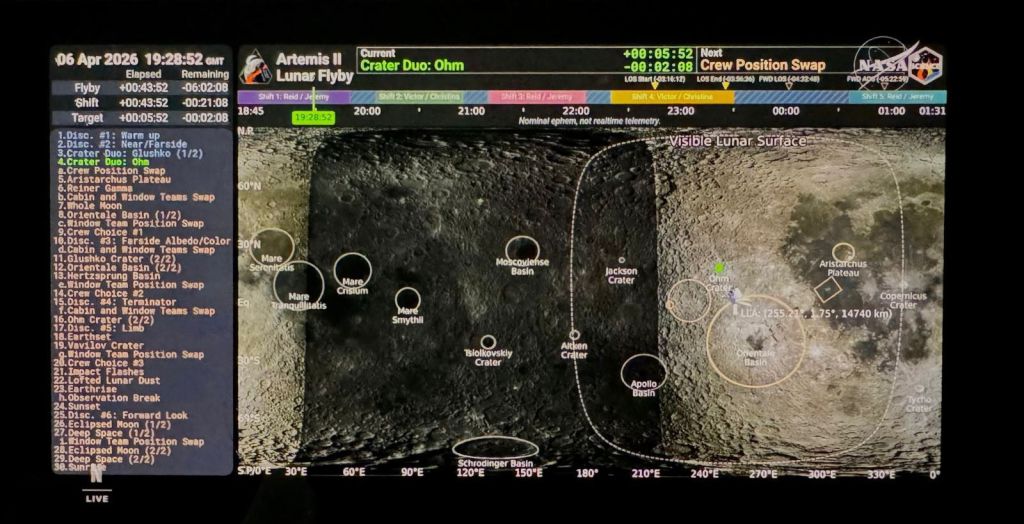
The climax of the mission came yesterday, on Flight Day 6. For about seven hours, the four astronauts observed features of the lunar surface and took photos. At their closest, the crew flew within 4,067 miles of the Moon’s surface.
The astronauts viewed never-before-seen parts of the Moon’s surface — areas on the far side that aren’t visible from Earth. Even the Apollo astronauts couldn’t view the Moon’s far side in this way because of the paths and timing of their flights.
The science objectives were well-defined ahead of time. NASA scientists had identified about 35 geological features for the crew to observe. Working in pairs, the astronauts took photos of the sites and described them in real time to scientists at Mission Control at the Johnson Space Center in Houston. Among the targets: the Orientale basin, a nearly 600-mile-wide crater that straddles the Moon’s near and far sides, formed 3.8 billion years ago when a large object struck the lunar surface. The crew also studied the Hertzsprung basin on the far side, and flew over features including the enigmatic Reiner Gamma — a lunar swirl, a weird pattern that exists in a handful of places on the Moon but nowhere else in the solar system, whose origin scientists still don’t fully understand.
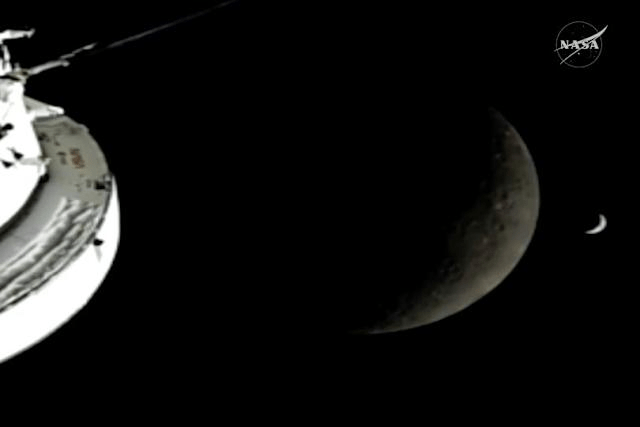
One of the more poetic moments came when Orion, the Moon, and the Sun aligned, causing a solar eclipse lasting nearly an hour. The crew used the opportunity to study the solar corona — the Sun’s outermost atmosphere — as it glowed around the lunar edge, and watched for flashes of light from meteoroids striking the surface. Pilot Victor Glover described the scene: the Sun had disappeared behind the Moon, the corona still blazing as a halo, and the Moon itself hanging before them as a black orb, with stars and planets visible behind it.
During the period when Orion passed behind the Moon, the mission experienced a planned communications blackout of about 40 minutes as the lunar surface blocked the radio signals between the Deep Space Network and the spacecraft. When contact was reestablished, the crew’s relief and excitement were palpable.
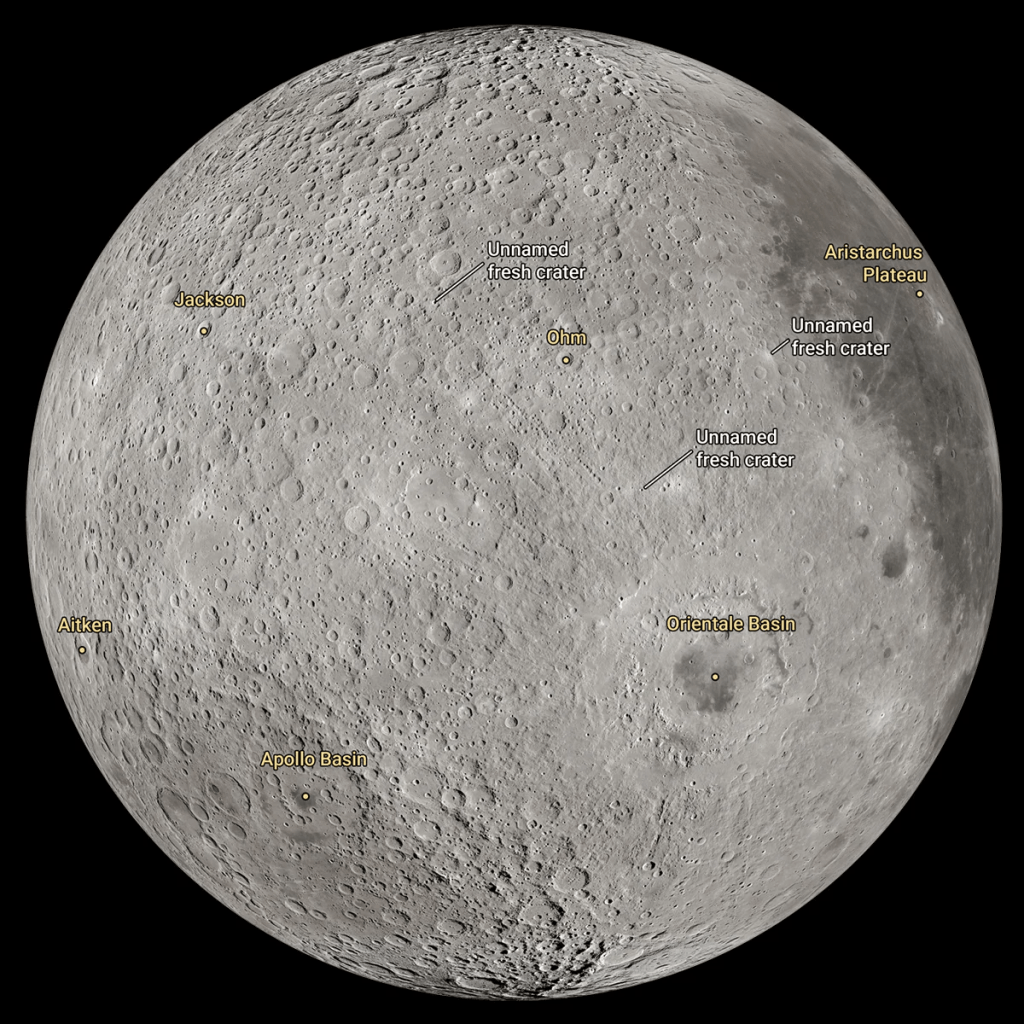
The astronauts also left a small mark on the Moon — literally. Canadian astronaut Jeremy Hansen proposed 2 names for unnamed craters on the ‘dark’ surface of the satellite. Just northwest of the Orientale basin, highlighted below, is a crater they would like to name Integrity after their spacecraft and this historic mission. Just northeast of the Integrity crater, on the near and far side boundary, and sometimes visible from Earth, the crew suggested an unnamed crater be designated Carroll in honor of Reid Weisman’s late wife, Carroll Taylor Wiseman, who passed away on May 17, 2020. After this mission is complete, the crater name proposals will be formally submitted to the International Astronomical Union, an organization that governs the naming of celestial bodies and their surface features
A Message from the Past
The flyby day began with an unexpected emotional note. The crew received a special pre-taped message from former NASA astronaut Jim Lovell, who flew on the Apollo 8 and Apollo 13 missions and died in 2025 at age 97 but had recorded the message before that. Lovell welcomed them to “his old neighborhood,” reminded them of what Apollo 8 meant to humanity, and told them not to forget to enjoy the view.
What Comes Next
The Artemis II mission is scheduled to splash down off the coast of San Diego at approximately 8:07 p.m. EDT on Friday, April 10. Following splashdown, recovery teams will retrieve the crew using helicopters and deliver them to the USS John P. Murtha, where the astronauts will undergo post-mission medical evaluations.
The data gathered during this mission — from the heat shield’s performance during reentry, to the life support tests, to the scientific observations of the lunar surface — will feed directly into planning for Artemis III, which aims to return humans to the lunar surface itself, potentially as early as 2028.
The Moon is no longer just a distant light in the sky. For the first time in 54 years, it is once again a place humans are visiting. And this time, we plan to stay.

Bibliography
- Artemis II — Wikipedia. Retrieved April 7, 2026.
- NASA Artemis Blog — NASA.gov. Mission updates retrieved April 6–7, 2026.
- NASA Sets Coverage for Artemis II Moon Mission — NASA.gov.
- NASA’s Artemis II Mission Leaves Earth Orbit for Flight around Moon — NASA.gov.
- Artemis II begins its journey to the moon: Highlights — CNN, April 1–3, 2026.
- Highlights: Artemis II astronauts circle the moon on record-breaking NASA mission — NBC News, April 6, 2026.
- Artemis II Flight Day 6: Crew Ready for Lunar Flyby — NASA.gov, April 6, 2026.
- Artemis II Flight Day 6: Lunar Flyby Updates — NASA.gov, April 6, 2026.
- NASA Answers Your Most Pressing Artemis II Questions — NASA.gov.
- Artemis 2 successfully launches toward the moon! — EarthSky.org.
- Artemis II astronauts heading home after historic moon flyby — NPR, April 6, 2026.
 Real Sheldon: a Science Blog
Leave a comment