
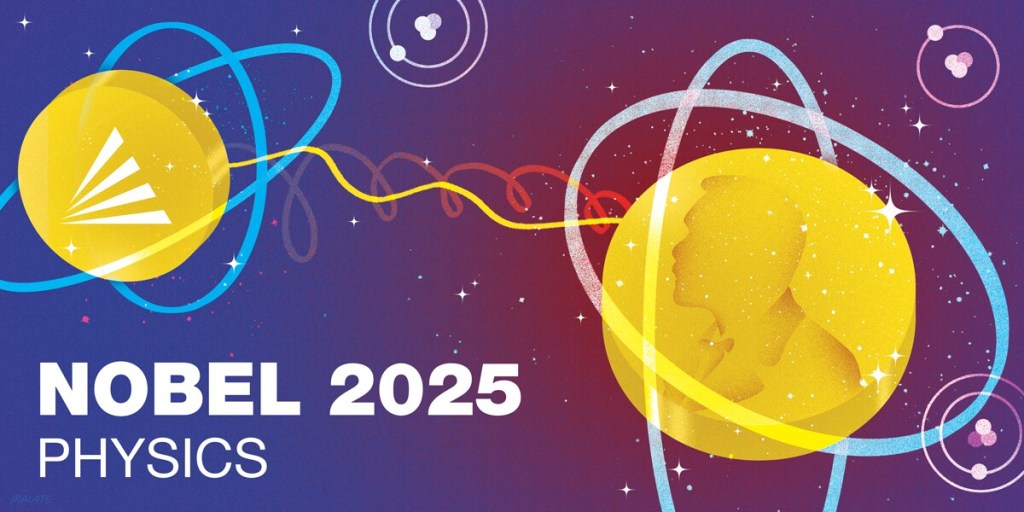
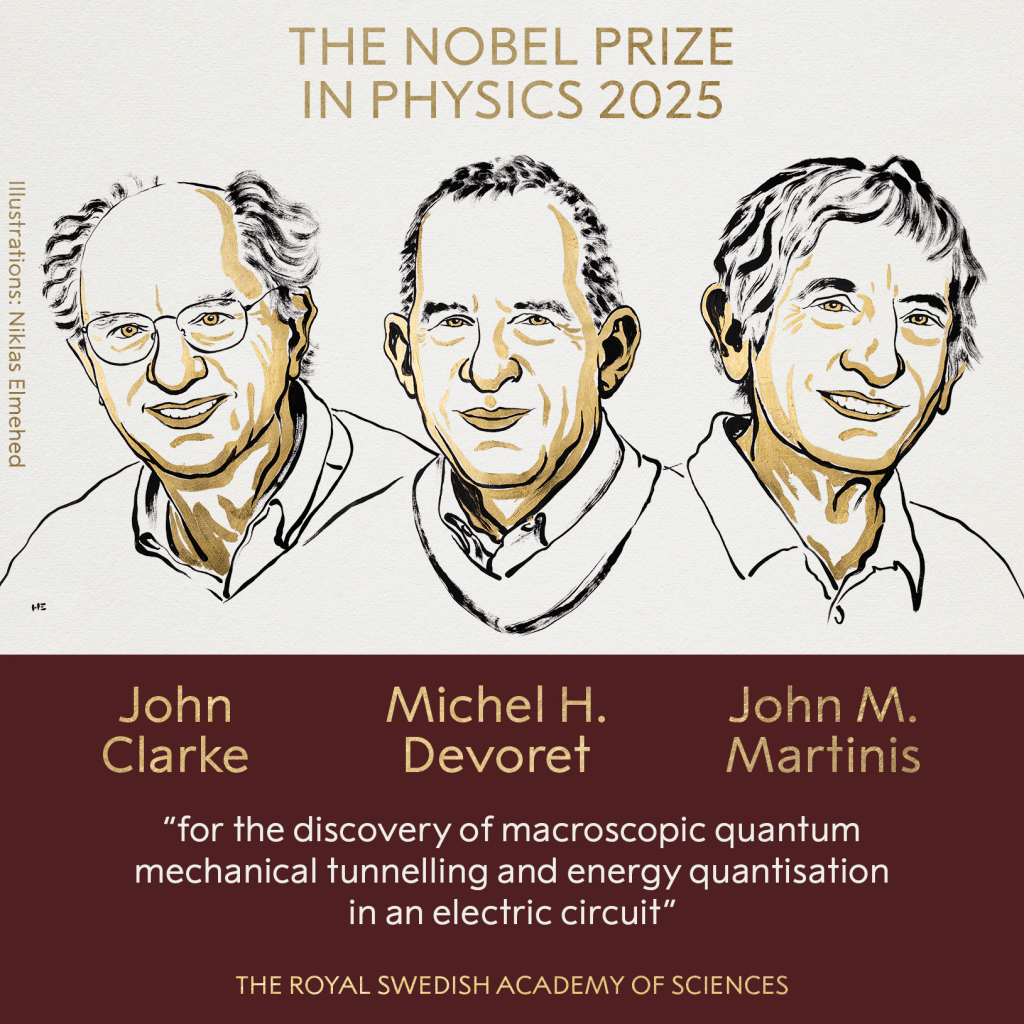
This year’s Nobel Prize in Physics was awarded to three scientists — John Clarke, Michel H. Devoret, and John M. Martinis — for work that pushes quantum physics out of the tiny world of atoms and into something you could almost hold in your hand. The announcement came from the Royal Swedish Academy of Sciences in October, and the formal award ceremony took place on December 10 in Stockholm, Sweden, as tradition dictates.
Who Won and Why It Matters
The 2025 Nobel Prize in Physics went jointly to:
- John Clarke
- Michel H. Devoret
- John M. Martinis
They were honoured “for the discovery of macroscopic quantum mechanical tunnelling and energy quantisation in an electric circuit.” NobelPrize.org
In simpler terms, they showed that the strange rules of quantum mechanics — normally only seen in tiny particles like electrons — can also appear in bigger systems you can actually hold or build in a lab. NobelPrize.org
What They Actually Discovered
Quantum mechanics is famous for being weird:
- Particles can tunnel through barriers they shouldn’t be able to cross.
- Energy comes in quantized chunks, not a smooth continuum.
These things were once thought to be purely microscopic – only happening at atomic or subatomic scales. But Clarke, Devoret, and Martinis built superconducting electrical circuits that showed these effects on a much larger, observable scale.
Their experiments let a system behave as if it were one giant quantum object: it tunnelled through energy barriers and absorbed and released energy only in discrete amounts, just like tiny quantum particles do.
That might sound abstract, but it’s a huge leap forward for quantum technology — especially for quantum computers, sensors, and communication systems that rely on these kinds of effects.

Why This Is a Big Deal
Traditionally, quantum effects were confined to the world of electrons, atoms, and photons. The Nobel winners proved you can engineer systems big enough to handle that still behave in quantum ways. That’s a major conceptual and practical milestone — it helps bridge the gap between theory and technology.
Not only does this deepen our understanding of physics, but it also helps lay the groundwork for the next generation of quantum technologies that may transform computing, cryptography, and measurement.
The Ceremony and Legacy
The laureates received their medals and diplomas at the Nobel Prize award ceremony in Stockholm on December 10, the anniversary of Alfred Nobel’s death. The event featured speeches, music, and the usual pomp associated with one of the world’s most prestigious honours — a celebration of science that impacts humanity.
This prize reminds us that physics is still full of surprises. What once seemed like abstract theory can become real, measurable, and useful.
 Real Sheldon: a Science Blog
Leave a comment