
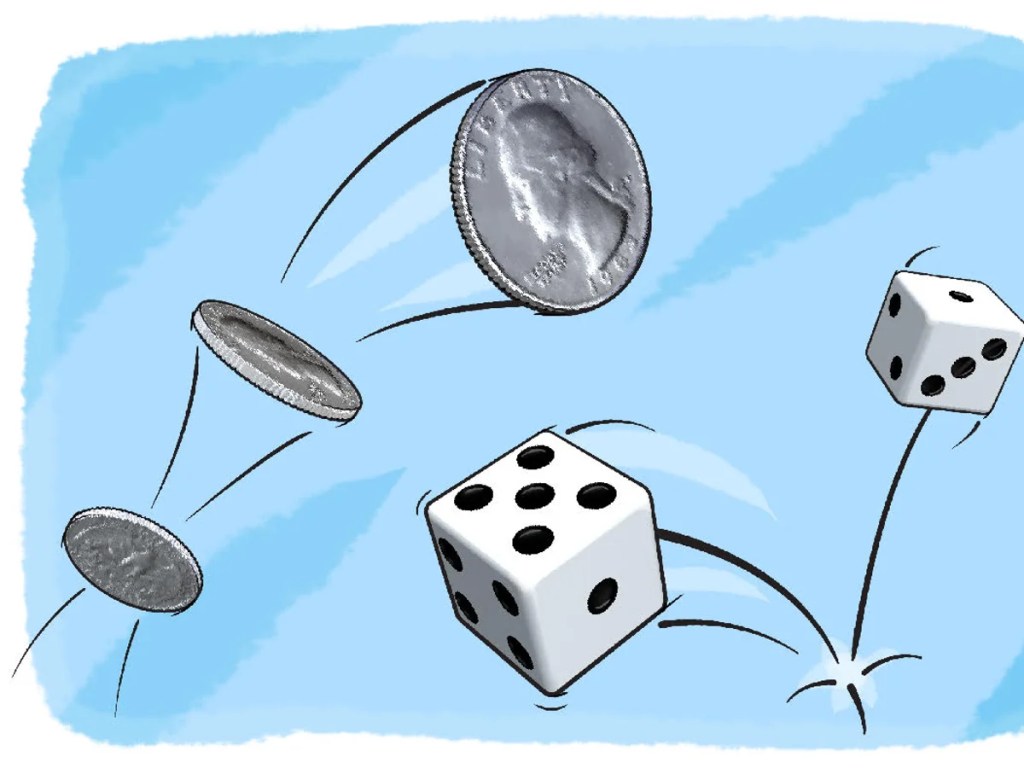
When we roll dice, shuffle cards, or even check the weather forecast, we’re unknowingly walking in the footsteps of centuries of mathematicians, gamblers, and philosophers who tried to make sense of chance. The history of probability is a mix of games, paradoxes, and surprising discoveries that shaped not only mathematics, but also science, economics, and daily life.
From Dice to the Birth of Probability
Games of chance are as old as civilization. Ancient dice have been found in Mesopotamia, Egypt, and even in Roman ruins. But for millennia, people treated luck as the domain of the gods, not something that could be measured.
That changed in the 17th century, when two Frenchmen, Blaise Pascal and Pierre de Fermat, exchanged letters about a gambling problem: how to fairly divide stakes in an unfinished game. Their correspondence in 1654 is considered the birth of probability theory.
Around the same time, Gerolamo Cardano, a Renaissance polymath (and avid gambler), had written about the mathematics of dice and betting, though his work was published only after his death. Together, these early thinkers laid the groundwork for a field that would later influence statistics, finance, and even physics.
Probability Goes Scientific
In the 18th century, probability left the gaming tables and entered science. Jacob Bernoulli formulated the Law of Large Numbers, showing that repeated trials tend to stabilize averages — the principle behind insurance, polling, and modern data science.
Later, Pierre-Simon Laplace expanded probability into a full-blown mathematical discipline, applying it to astronomy, statistics, and even philosophy. By the 19th and 20th centuries, probability became essential in physics (quantum mechanics), genetics, and computer science.
Curious and Surprising Facts
- 🎲 The dice paradox of Chevalier de Méré: A 17th-century nobleman believed he had found a winning dice strategy — until math proved him wrong. His paradox actually prompted Pascal and Fermat’s famous correspondence.
- 📊 Probability in insurance: One of the first real-world applications was in life insurance. Actuaries used mortality tables to calculate fair premiums — literally betting on human lifespan.
- 🔄 Monty Hall Problem: This modern puzzle, based on a TV game show, shows how our intuition about probability often fails. Most people resist switching doors — even though switching doubles your chances of winning.
- 🔬 Quantum uncertainty: In physics, probability isn’t just about ignorance. Quantum mechanics suggests that probability is woven into the fabric of reality itself.
- 🍀 The Birthday Paradox: In a room of just 23 people, there’s about a 50% chance that two share the same birthday. In 75 people, the probability jumps to 99.9%!
Why It Still Matters
Today, probability drives everything from AI algorithms and weather forecasting to stock markets and medical trials. What began as gamblers trying to beat the odds has grown into one of the most powerful tools humans have to understand uncertainty.
So, the next time you flip a coin or roll a die, remember: behind that small act lies centuries of curiosity, paradoxes, and breakthroughs that continue to shape our world.

 Real Sheldon: a Science Blog
Leave a comment