
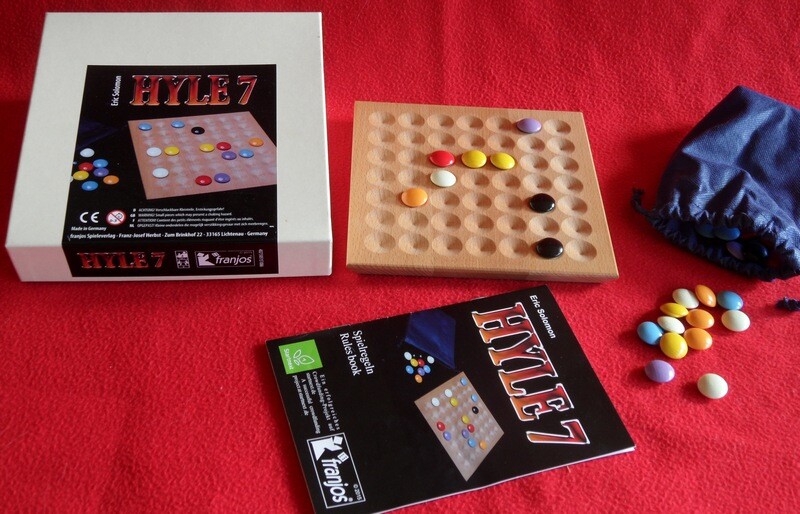
Entropy — also known as Hyle 7 — is a deeply elegant, fiercely logical, and virtually forgotten abstract strategy game. Despite its inclusion in international competitions such as the International Logic Olympiad, it has no widely published manual, no commercial edition, and little documentation online.
Yet, those who encounter Entropy often discover a minimalist gem that rivals the best of abstract design: a pure duel of pattern and disorder, where symmetry itself becomes a battleground.
Overview
- Players: 2 (asymmetric roles: Order vs. Chaos)
- Board: 7×7 grid
- Components: 49 coloured disks in 7 distinct colours (7 of each)
- Playtime: 10–15 minutes
- Setup: Minimal — a bag of shuffled disks and an empty grid
- Chance: None in rules, but Chaos may use randomness
- Design Origin: Unknown (designed pre-2000, revived via logic Olympiads)
How to Play
The board starts empty. A bag contains 49 disks, 7 in each of 7 colours.
- Chaos draws one disk at a time from the bag (or follows a predetermined randomized sequence) and places it on any empty square.
- Order can move only 1 disk like a rook in the game chess and scores points after the board is full, based on visible patterns of symmetry.
This division of roles creates an elegant asymmetry: Chaos acts, Order evaluates. One disrupts, the other preserves.
Scoring (Standard Tournament Rules)
Scoring
Once the grid is full, Order scores points based on the number of symmetrical groups of adjacent tokens of the same color. A group scores if it meets all the following conditions:
✅ Symmetry Criteria (Palindrome Rule)
A group of tokens counts as symmetrical if:
- All tokens in the group are of the same color
- The tokens are placed in a straight line (horizontal or vertical)
- They form a palindrome — that is, the sequence reads the same forward and backward
- The group is entirely contiguous (no gaps)
There are no diagonal scores and no mirror symmetry beyond simple palindromes.
Bear in mind that you should count palindromes inside palindromes if you can:
🔴🔴 2 points
🟡🟡🟡 3 + 2 + 2 so 7 points
🟡🔵🟡 3 points
🔴🟡🔵🟡🔴 3 + 5 so 8 points
and so on
Strategy
- Chaos often aims to disrupt potential scoring zones, especially central symmetry lines.
- Order may attempt to steer Chaos (via temptation or threat) into completing symmetric structures.
- Since placement is purely Chaos’s decision, Order’s influence is indirect and reactive — the challenge lies in recognizing, not constructing, order within disorder.
High-level play involves:
- Pattern tracking
- Symmetry mapping
- Probabilistic inference
- Psychological pressure
Competitive and Educational Use
Entropy has been featured in:
- International Logic Olympiad (ILO)
- Maths and logic summer camps
- University logic competitions
It’s particularly well-suited to:
- Teaching symmetry and pattern recognition
- Exploring asymmetry in game design
- Solo logical training (self-play as both Chaos and Order)
Where to Learn More
Because the game is unofficial and has no central publisher, documentation is community-driven. Here are some useful resources:
- BoardGameGeek Entry (create or edit)
- International Logic Olympiad (archive of past games and events)
- Wikipedia – Entropy (game theory) (note: not specifically about Hyle 7 but useful background)
- Custom 3D sets and analysis by independent creators (e.g., user-made photos and evaluations)
A dedicated manual and analysis text — Entropy: A Matter of Perfection — is also in development and may become the first complete published source.
Final Thoughts
Entropy is one of those rare games that seems to exist outside time. With no branding, no official publisher, and no commercial push, it nevertheless offers a unique challenge rooted in the heart of logic and aesthetics.
It deserves a revival.
Whether through self-play, digital implementation, or academic interest, Entropy offers something that many modern games do not: a perfect balance between chaos and order — and a score that measures only your ability to find it.
 Real Sheldon: a Science Blog
Leave a comment