
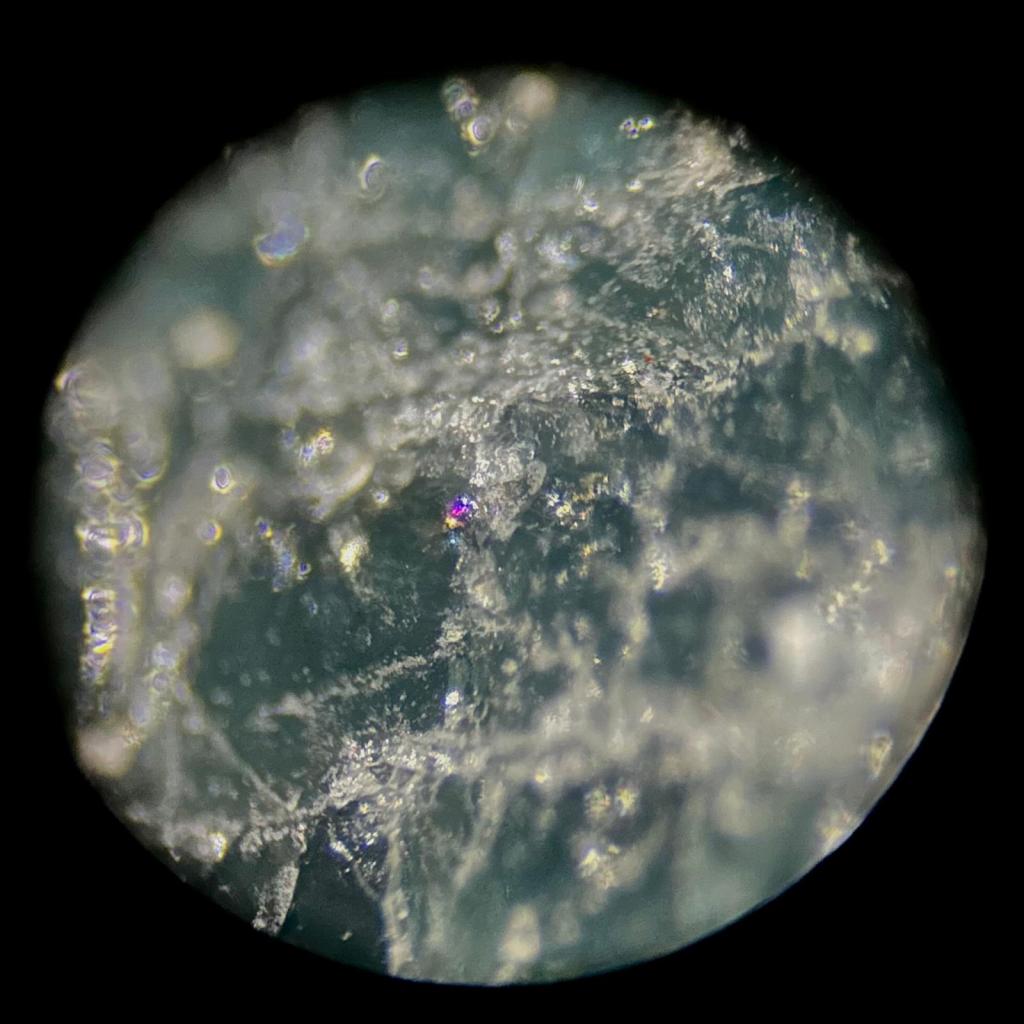
Under magnification, apatite transforms from a common mineral into a canvas of fractal elegance. This image reveals the mineral’s typical blue-green tone swirling in crystalline chaos—yet what draws the eye is not its familiar structure, but a vivid anomaly: a glowing red speck embedded deep within.
Apatite, a group of phosphate minerals, is perhaps best known for its biological role. In the natural world, it’s a foundational component of bones, teeth, and even fossilized remains. Its name comes from the Greek word apatáō [ἀπάτη, ἀπατάω], meaning “to deceive,” due to its frequent confusion with more valuable gemstones. But beyond biology and gemology, apatite plays a quiet yet vital role in agriculture—as the primary source of phosphorus in fertilizers, it sustains the growth of global crops.

Historically, apatite hasn’t commanded the spotlight like quartz or diamond, but its utility is profound. In some spiritual circles, especially when cut as a gemstone, it is said to enhance clarity, focus, and personal power—its translucent tones lending themselves to metaphysical symbolism.
Yet, in this microscopic capture, utility gives way to curiosity. The red formation is not characteristic of apatite’s usual inclusions, prompting speculation. Could it be a trace element? A micro-particle from handling? Or something more? Like a rogue signal in a sea of order, it disrupts expectations and invites inquiry.
In science, anomalies often open doors. And in this single, magnified frame, apatite offers not just structure and history—but a story still unfolding.

 Real Sheldon: a Science Blog
Leave a comment